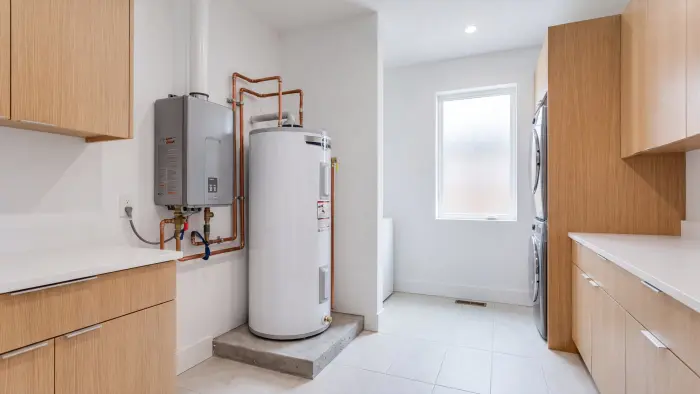

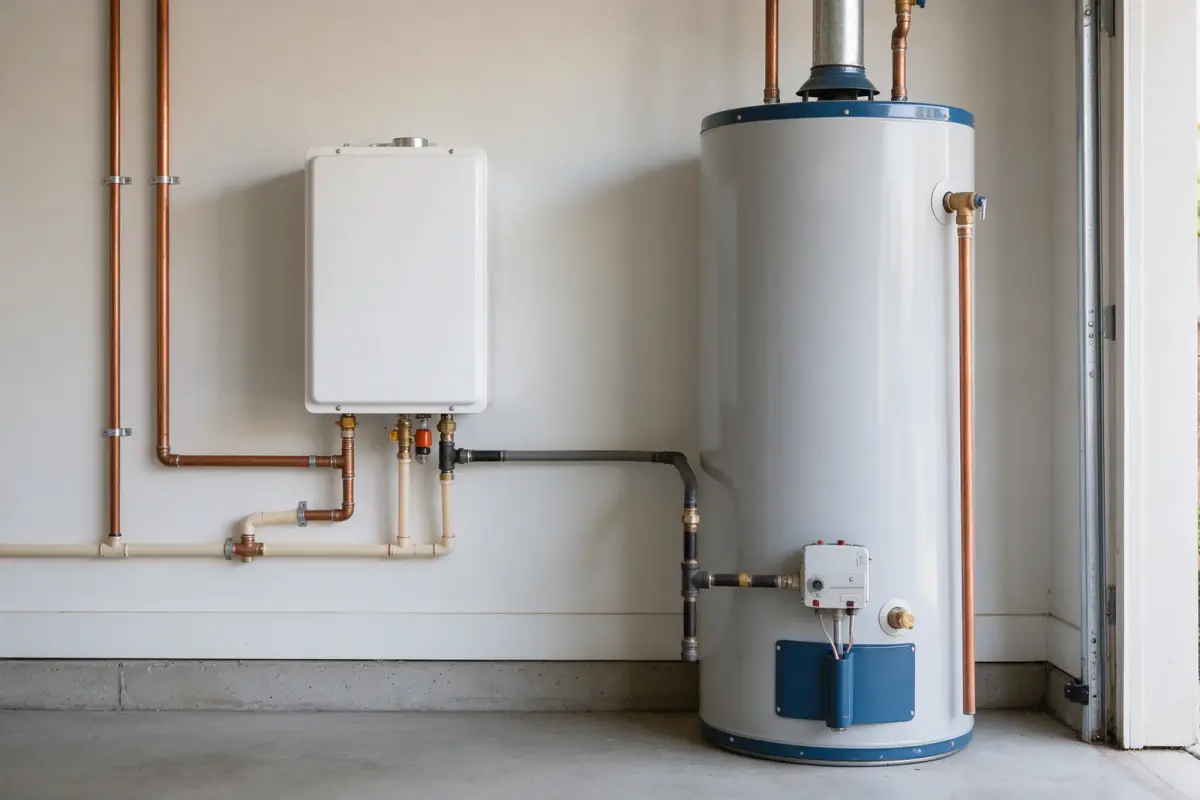
A traditional tank water heater is the better choice if you want the lowest upfront price or may move within a few years. A tankless heater makes more sense if you'll stay 10 years or more, have gas service, and want hot water that doesn't run out. Tankless usually costs two to three times as much to install, but it uses less energy and lasts about twice as long.
Here's how the two compare on the points that decide it for most households.
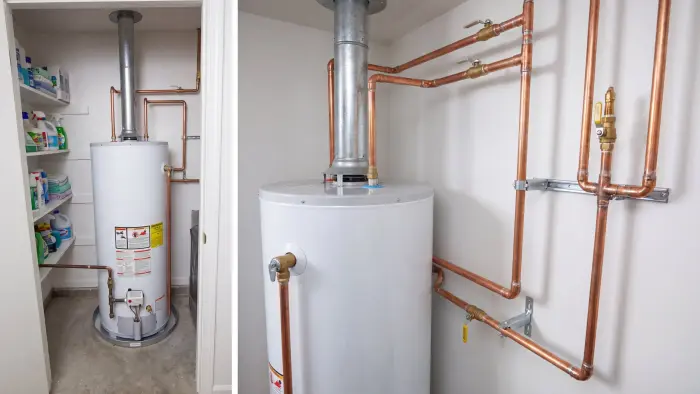
A tank water heater stores 40–50 gallons (sometimes more) and keeps it hot all day and night. When you use hot water, cold water refills the tank and the burner or elements heat it back up.
A tankless water heater stores nothing. When you open a hot tap, water flows through a heat exchanger and gets heated in seconds. When you close the tap, the unit shuts off. Tankless units come in gas and electric versions, but gas is the usual whole-house choice.
This is where a tank wins clearly. Replacing a 40- or 50-gallon gas tank is a simple job because the gas line, flue and connections are already in place. Switching to tankless usually means a larger gas line, new venting, a 120-volt outlet and a permit, so a conversion commonly costs two to three times as much as a tank swap. Replacing an existing tankless unit with a new one costs much less than a first-time conversion.
For the actual ranges, including unit versus installed prices and what each upgrade adds, see our full breakdown of how much a tankless water heater costs.
A tank loses heat all the time, even overnight and while you're at work. A tankless unit uses energy only while hot water is running. The U.S. Department of Energy estimates tankless heaters are 24–34% more energy efficient than standard tanks in homes that use 41 gallons of hot water a day or less, and 8–14% more efficient in homes that use around 86 gallons a day. ENERGY STAR puts the savings for a family of four with a certified gas tankless unit at about $95 a year compared with a standard gas tank.
That's real money, but it's not enough to pay back the higher install cost quickly. If you're choosing tankless mainly to lower your gas bill, expect a long payback.
A gas tank typically lasts 8–12 years and an electric tank 10–15 years. Sediment and corrosion inside the tank are what usually end its life. A tankless unit has no tank to rust out, and with yearly descaling it commonly lasts 20 years or more. Over two decades, one tankless unit can outlast two tanks. That's the strongest financial argument for tankless, and it only works if you stay long enough to benefit.
The two types run short in different ways.
A tank gives you as much hot water as it holds, plus whatever it can reheat while you're using it. Back-to-back showers, a big soaking tub, or laundry during shower time can use it up. Then you wait while it recovers.
A tankless unit never runs out, but it can only heat so many gallons per minute. If you ask it to supply too many fixtures at once, the water turns lukewarm. Winter makes this worse. In Sacramento, water comes in colder in January, so the unit has to heat it more and delivers fewer gallons per minute. A properly sized gas unit handles two showers at once, but an undersized one will let you down on cold mornings. Our guide to choosing the right water heater size covers flow rates for both types.
Tankless has two other quirks. A very low trickle may not be enough to switch the burner on. And if you turn a hot tap off and back on quickly, you can get a short burst of cooler water before the heat catches up. Most people get used to both, but it's better to know about them before you buy.
A tank takes up floor space in a garage, closet or attic, and California requires tanks to be strapped against earthquakes. A tankless unit mounts on the wall and is roughly the size of a carry-on suitcase, which frees up floor space. Outdoor models can go on an exterior wall. In exchange, tankless needs more infrastructure: a bigger gas supply, sealed venting to the outside, and power.
Both types need yearly attention, just different kinds.
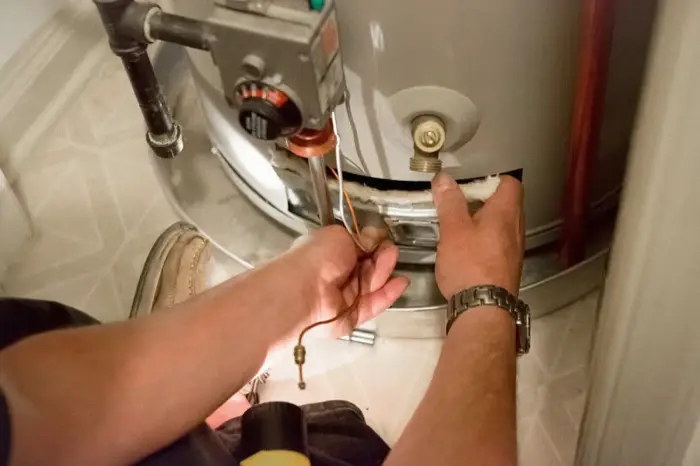
- Tank: Flush it once a year to clear sediment, and have the anode rod checked every few years. Skipping this shortens the tank's life.
- Tankless: Descale it once a year, or more often with hard water, by circulating a descaling solution through the heat exchanger. Clean the inlet filter screen at the same time. Scale reduces output, and many manufacturer warranties exclude scale damage.
If you'd rather not do it yourself, our water heater maintenance and repair services cover both tank and tankless units.
A gas tankless unit needs electricity for its controls, fan and ignition, so it stops making hot water during a power outage. Many standard gas tanks with a standing pilot keep working without power. If outages are common where you live, that's worth factoring in.
If your home is all-electric, or you're open to switching from gas, there's a third option. A heat pump water heater is a tank that moves heat from the surrounding air into the water instead of making heat directly. It costs more upfront than a standard tank but is very efficient to run. It needs space and air around it, and a Sacramento garage usually works well. SMUD's current water heater rebates also focus on heat pump models, not tankless. Our guide to whether heat pump water heaters are worth it goes through the tradeoffs.
- You need the lowest upfront cost, or your tank just failed and the budget is tight
- You expect to sell within a few years
- You rarely run out of hot water now
- You want hot water during power outages
- You'd rather not deal with a gas line or venting upgrade
- You plan to stay 10 years or more
- You regularly run out of hot water, or you have a large tub
- You have gas service, or your gas line can be upsized
- Floor space is tight
- You'll keep up with yearly descaling
Does a tankless water heater really save money?
Yes, on energy, but less than many people expect. ENERGY STAR estimates about $95 a year for a family of four with a certified gas unit. The bigger savings come from lifespan, because a tankless unit that lasts 20 years or more can save you from buying a second tank.
Can a tankless water heater run out of hot water?
It won't run out, but it can fall behind. If too many fixtures run at once, or cold winter inlet water pushes an undersized unit past its limit, the water gets lukewarm. Sizing the unit for your household's peak use prevents this.
Is it worth replacing a working tank with tankless?
Usually not. Replacing a tank that still works throws away its remaining life. It's generally smarter to plan the switch for when your tank nears the end of its life, often around the 8–12 year mark for gas, so you're not deciding under pressure after a failure.
Not sure which fits your home? We can look at your gas line, venting and household hot water use and recommend a type and size. Contact Beaver Brothers Plumbing to set up a visit, and ask about our current water heater special — new tank or tankless units installed from $2,999.