
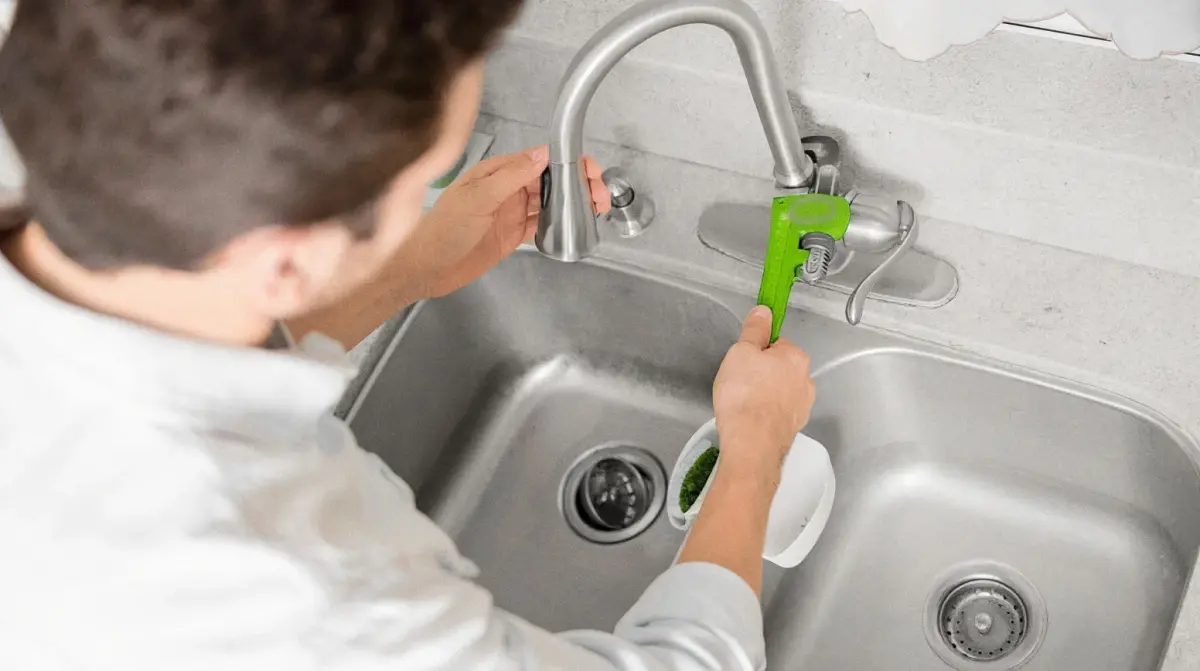
A stripped faucet handle spins without turning the water on or off because the small teeth that lock it to the valve stem have worn smooth, on the handle, the stem, or both. If only the handle is worn, you fix it by fitting a new handle, which takes 10 to 15 minutes once you have the part. If the stem is worn, you replace the stem or cartridge instead.
On most faucets, the top of the valve stem is cut with fine vertical ridges called splines. The inside of the handle has matching grooves, so turning the handle turns the stem. A screw on top (usually hidden under a decorative cap) or a small set screw on the side holds the handle in place.
Handles are often made of zinc alloy or plastic, which is softer than a brass stem, so the handle's grooves usually wear out first. Plastic cartridge stems can wear too. The usual causes are:
- Cranking the handle to stop a drip. This is a very common cause. If the washer or cartridge is worn, people turn the handle harder until the splines give way. Fix the drip too, or the new handle will strip as well. Here is why a small leak is worth fixing quickly.
- A loose handle screw. A handle that rocks on its stem slowly grinds the splines down.
- Corrosion or mineral buildup between the handle and the stem.
- The wrong replacement handle. A handle that almost fits will strip quickly.
- Flathead and Phillips screwdrivers, plus a set of hex (Allen) keys in inch and metric sizes
- A small flathead screwdriver or utility knife to pry off the decorative cap
- An adjustable wrench
- Penetrating oil and a faucet handle puller, if the handle is stuck
- A rag, a flashlight, and silicone plumber's grease
- A replacement handle: either one made for your faucet brand, or a universal handle kit with spline adapters
- A new handle screw, since old ones are often corroded
- A replacement stem or cartridge, if the stem turns out to be the worn part
Take the old handle and stem or cartridge to the store if you can. Many major faucet brands offer lifetime warranties on parts for the original owner, so check yours before you buy anything.
Close the supply stops under the sink by turning them clockwise, then open the faucet to release the pressure. Tub and shower valves often have no separate shut-off, so you may need to close your home's main valve. Put a rag over the drain so small screws cannot fall in.
Pry the decorative cap (often marked H or C) off the top of the handle and take out the screw underneath. Single-handle faucets often use a set screw on the side or back instead. Loosen it with a hex key; you do not have to take it all the way out.
Lift the handle straight up. If it is stuck, apply penetrating oil where the handle meets the stem, wait 10 to 15 minutes, and try again. If it still won't come off, use a handle puller. Don't pry against the faucet body with a screwdriver, because that chips the finish and can bend the stem.
Look at both parts with a flashlight:
- The stem is fine if the splines are crisp, pointed, and all the same height.
- The stem is worn if the splines are rounded, flattened, or missing.
- The handle is worn if the grooves inside it look smooth, or the insert is cracked or loose.
- The screw hole is the problem if the splines look fine but the screw will not tighten. Try a new screw first. If the threads inside the stem are damaged, the stem or cartridge needs replacing.
A quick test: push the old handle onto the stem without the screw and try to turn it. If it slips but a new handle grips firmly, the old handle was the problem.
If only the handle is worn, replace it. A handle made for your brand fits best, but a universal kit also works on many faucets: choose the splined adapter that fits your stem snugly, press it into the handle, and install the handle as normal.
An adapter fixes a worn handle, not a worn stem. If the stem's splines are rounded off, nothing will grip them for long.
Put a light coat of silicone plumber's grease on the stem splines so the handle comes off more easily next time. Set the handle at its original angle, tighten the screw until it is snug but not forced, and replace the cap. Turn the water back on slowly and check that the handle opens and closes the valve fully.
Look at the stem or cartridge if its splines are worn or its screw threads are stripped, if the handle turns but the water does not respond, or if the faucet still drips when it is fully off.
Older two-handle faucets usually use compression stems. You unscrew them with a wrench and replace them with an exact match. Most newer faucets use a cartridge held in by a nut or clip. Replace it with a cartridge made for your brand, grease the O-rings, and install it facing the same way as the old one so hot and cold stay on the correct sides. If your faucet is old, corroded, or its parts are no longer made, replacing the whole faucet is often the better choice.
If you can't get the part today and the splines are only slightly worn, wrapping a few layers of plumber's tape around the stem can give the handle enough grip to get by. It will loosen again, so treat it as a fix for a day or two.
If you do it yourself, a replacement handle usually costs about $15 to $50, and a cartridge costs roughly $10 to $100 depending on the brand. Most 2026 cost guides put a professional handle or cartridge replacement at roughly $75 to $250 in total, and a large part of that is the service-call fee. Local quotes vary. For costs of other small jobs, see our guide to common plumbing repair costs.
Call a plumber if the supply stops will not close or start leaking when you turn them (older stops often do), if the stem is seized in the faucet body, or if the handle belongs to a tub or shower valve behind the wall. For help deciding, see when to call a plumber and when to DIY. Our faucet and fixture repair service handles all of these.
If you would rather not tackle it yourself, get in touch with Beaver Brothers Plumbing and we will take care of it.
Can you fix a stripped faucet handle without replacing it?
Only temporarily. Plumber's tape around the stem can help a slightly worn handle grip for a short time, but you cannot restore worn splines. Replace the handle, or the stem or cartridge if that is the worn part.
Is a stripped faucet handle an emergency?
Usually not, as long as you can still turn the water off. If the handle spins and the faucet is stuck open, close the supply stop under the sink or the main valve, then fix it without hurrying.
Will a universal faucet handle fit my faucet?
Often, yes. Universal kits include adapters for the most common spline patterns, though a handle made for your brand fits more precisely.
Why does my new faucet handle keep stripping?
Usually the stem splines are worn, the adapter is the wrong size, or the handle is being overtightened to stop a drip. If the faucet drips when it is off, replace the washer or cartridge so the handle stops taking the strain.